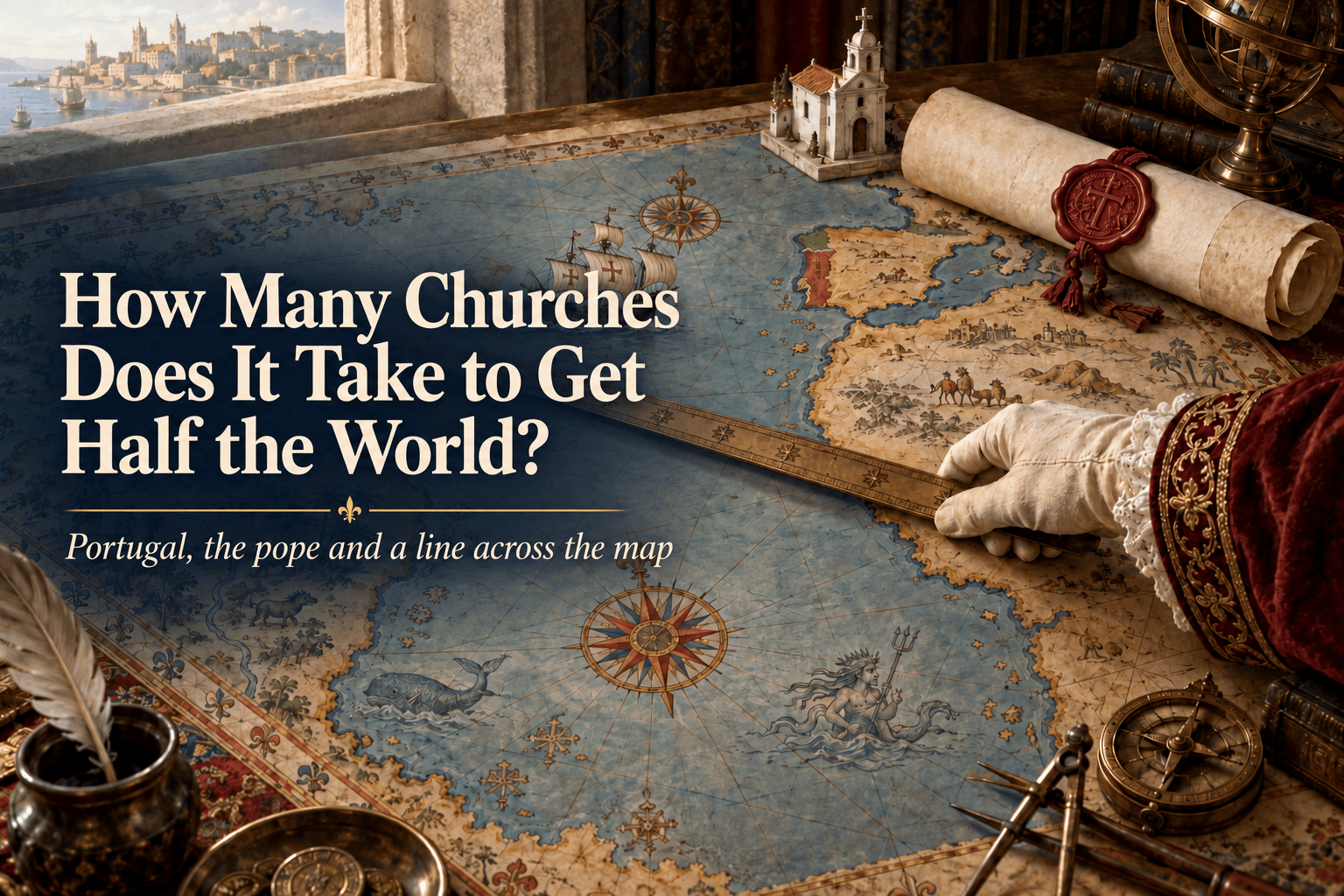
Rob (He’s is an exceptionally well-read and knowledgeable man) told me the pope once promised Portugal half the world, provided the Portuguese built enough churches.
Half the world? In exchange for churches?
Living in Portugal, I have to admit they seem to have taken the building part seriously. Even a village without a bakery usually has a church. Sometimes two, just in case the first one is busy. But I wanted to know whether a pope had ever sat down with a map and a church-building target.
The answer is more interesting than the story.
The pope did have a say
In the fifteenth century, Portuguese ships were sailing farther and farther down the African coast. Their crews were looking for trade routes and wealth. The king was keen to make sure nobody else got there first. A papal blessing was useful.
In 1455, Pope Nicholas V issued a document called Romanus Pontifex. It backed Portuguese claims along the African coast and granted extensive trading privileges. Spreading Christianity was presented as part of the enterprise.
Churches appeared in the document too. The Portuguese king was allowed to found churches and monasteries in territories under his control and to send clergy there. Allowed is the important word. The text sets no target of churches to be built before Portugal could claim a particular piece of land. There was no price list: ten chapels for an island, fifty for a coastline.
Religion sailed aboard those ships alongside trade, politics and weapons. The consequences were brutal. Papal support also helped justify the conquest and enslavement of non-Christian people. That part of the story is easy to lose behind an attractive façade covered in azulejos.
A line through the ocean
So where does “half the world” come from? For that, we need to jump forward almost forty years.
After Columbus’s voyage, Portugal and the Spanish rulers disputed their claims across the Atlantic. Pope Alexander VI had a hand in the first proposed boundary. But the division we remember was negotiated by the two kingdoms themselves in the Treaty of Tordesillas, signed in 1494.
They drew an imaginary line from north to south, 370 leagues west of the Cape Verde islands. A league was an old measure of distance. Claims on one side went to Castile; claims on the other went to Portugal. Imagine taking a ruler to a map and saying, “This bit is mine.”
The people already living on those lands were, of course, not invited to the table.
The line put the eastern part of present-day Brazil in the Portuguese sphere. It helps explain why Portuguese became the language of Brazil while Spanish became dominant across much of the surrounding region. That is the very short version. Brazil’s history was far messier than a straight line on a map.
And all those churches?
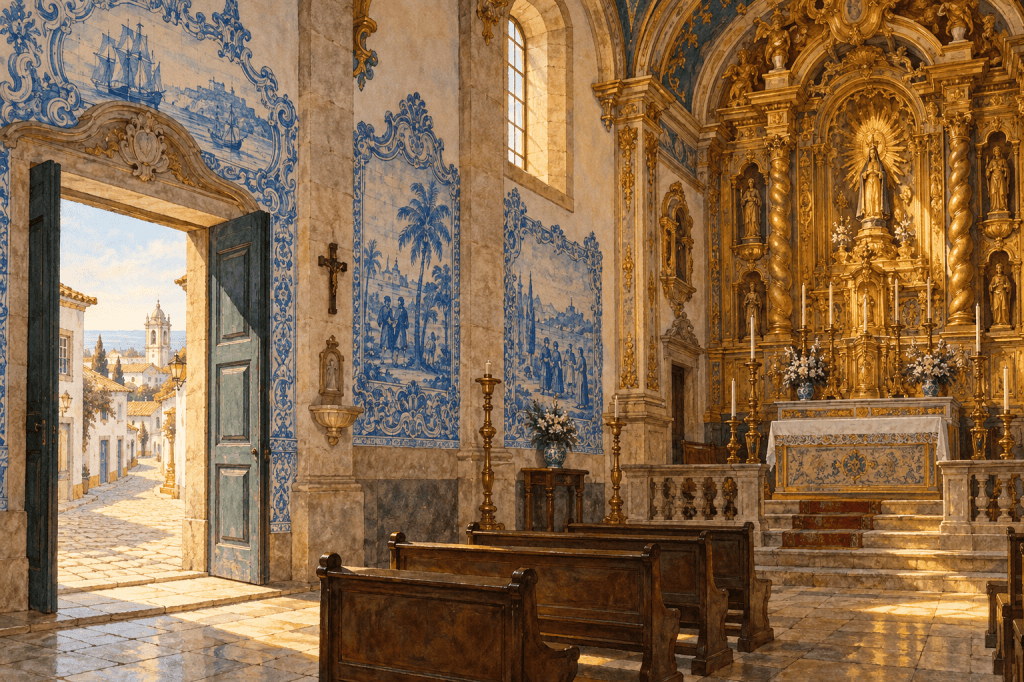
The Portuguese Crown later played a major role in organizing the Catholic Church overseas. Monarchs supported priests and missions and financed church building. This arrangement became known as the Padroado Português, or Portuguese royal patronage.
Now we have all the ingredients of Rob’s story: papal privileges, a kingdom spreading the faith, churches being built, and a later treaty dividing vast overseas territories between Portugal and Spain. Leave those ingredients to simmer for five centuries and out comes: “The pope gave Portugal half the world in return for enough churches.”
It is a terrific dinner-table story. As history, it goes a little too far.
The churches you see across Portugal today were not all built as part of one papal bargain either. Over many centuries, kings, religious orders, local brotherhoods and wealthy families paid for them. Wealth connected to colonial trade also found its way into the decoration of religious buildings.
Since Rob told me his version, I look at a Portuguese church differently. First I see the stonework, the tiles and the gilded altar. Then I think of that extraordinary time when two monarchies drew a line through an ocean and a pope believed he had a say in what lay beyond it.
I have stopped counting the churches, though. Nobody has found a receipt stating how many were needed for half the world.
Sources
- Romanus Pontifex (1455), English translation of the papal bull. The document includes trading privileges and permission to found churches and monasteries.
- UNESCO, Treaty of Tordesillas (1494). On the negotiations, dividing line and Brazil.
- Library of Congress, European claims to Brazil.
 Liesbeth van Duijn